Famous Space Explorers - Exploration of Space
Increased political tensions between Soviet Unionand the United States in the middle and
late 20th century gave the birth of the age that we today call as Space Race. From the end of World War II all up to 1975, these two countries
tried to achieve supremacy in scientific exploration using artificial satellites, orbital manned flights, and deep space missions to the moon. This
competition brought with itself (until then) unseen amounts of scientific military research, which created enormous amounts of beneficial spin off
technologies that are today used in in many other industries.
The greatest heroes from that time are without the doubt brave astronauts and cosmonauts who were the first to explore the
unknown environments in space. However, before the scientists were able to create technologies and procedures for manned flights, for more than 10
years they tested on the animals. The importance of space animals cannot be overstated - they provided integral role in those early year of space
exploration by providing the scientist the data from then unknown space environment . Some of the most famous animals from that time were the Soviet dog
Laika (first animal who orbited the Earth in 1957), American monkeys Able and Barker (who were
the first animals that successfully returned to Earth in 1959), and chimpanzee Ham (first chimp in space, who was also trained to
operate with simple mechanical switches during his flight).
In April 12, 1961, first human went to space. After orbiting the earth for 1 hour and 48 minutes, Soviet Cosmonaut
Yuri Gagarin successfully returned to Earth in his Vostok 1 spacecraft, instantly becoming worldwide celebrity. The news
of his flight spread across the world, and only few weeks later American astronaut Alan Shepard went to the space onboard the Mercury
program spacecraft called Freedom 7. Later, he would become fifth man that walked on the moon.
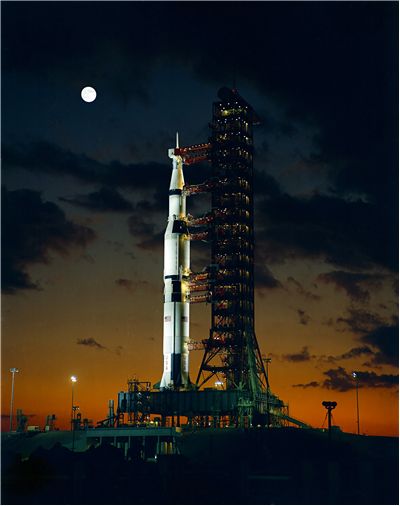
When the manned space flights became reality, both America and USSR set their sights on the exploration of moon. After less
than a decade of frenzied scientific research, American space mission Apollo 11 successfully landed on the surface of the moon on July 20, 1969. In
the one of the greatest televised events in the human history, audiences across the world watched the first Moon steps of astronaut Neil
Armstrong. This mission is today remembered as one of the most important discoveries of the human kind. After the successful return of Apollo 11 (Neil
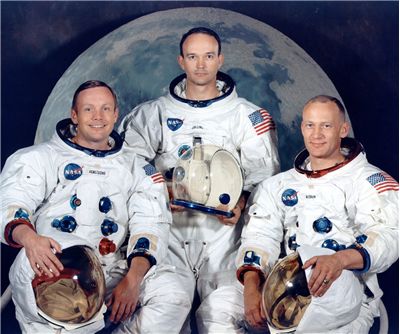
Armstrong, Michael Collins, Edwin "Buzz" E. Aldrin, Jr.), NASA launched five more lunar landing missions. One of the more publicized missions from that time was the Apollo 13 (crew James A. Lovell, John L. Swigert and Fred W. Haise), which
became severely damaged during flight and after several days of extreme hardship it safely landed back on Earth.
After the end of Apollo program in 1972, and the first cooperation between America and Soviet Union in 1975, manned
exploration of space shifted focus from the single missions to the establishment of permanent space stations. During the last 40 years, many astronauts visited
the various space stations in Earth's orbit (Skylab, Mir, and International Space Station).
The future of human exploration beyond Earth's orbit is still unknown. Newly formed space agencies from developing countries
(India and China) aim to send manned missions to the Moon in the next 15 years, while American scientist want to send human mission to explore near
asteroids in the next 20 years. Hopefully, mission to Mars will not be far behind.